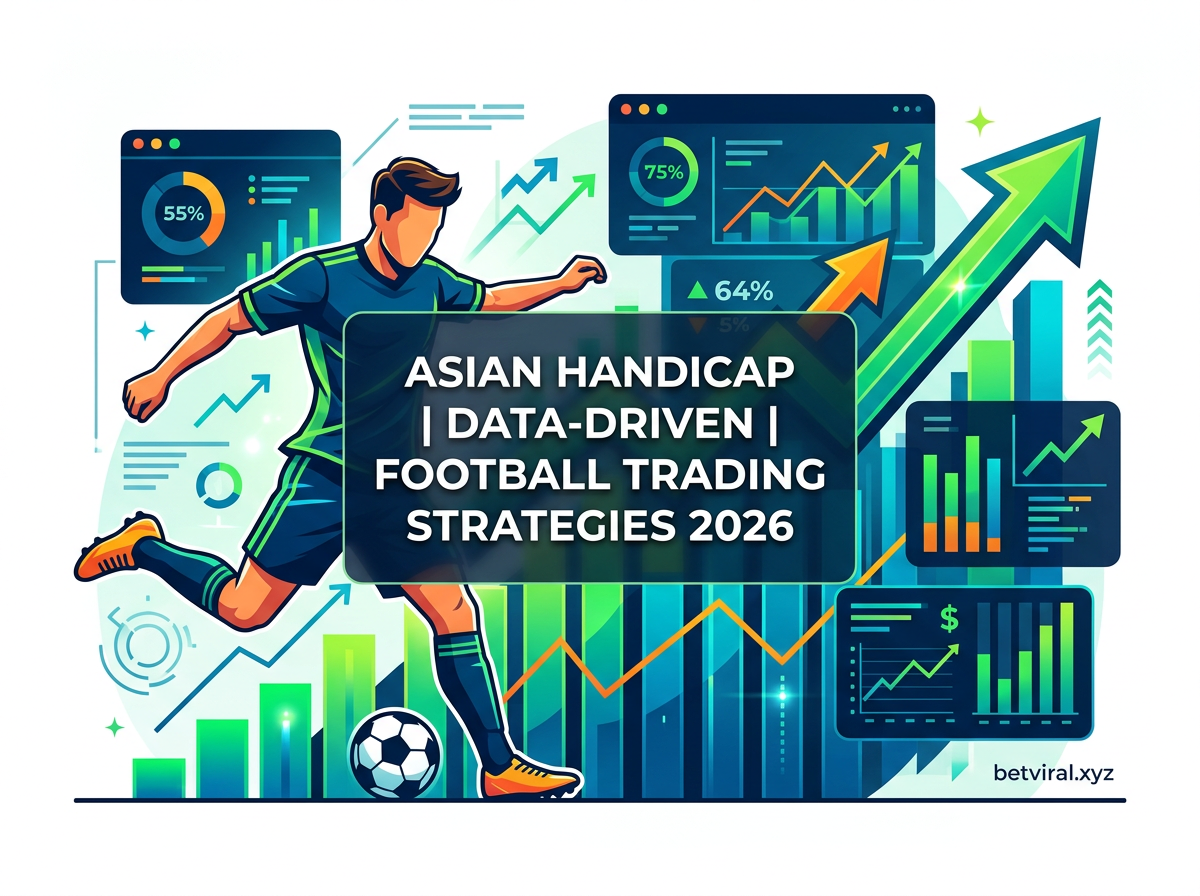
Introduction
In the sophisticated world of sports betting, professional traders often look beyond simple win-draw-win markets to find value. For the analytical bettor aged 25-45, the Asian Handicap (AH) represents the pinnacle of strategic trading. Unlike traditional markets, the Asian Handicap eliminates the possibility of a draw, effectively narrowing the outcomes and providing a more granular way to assess a team’s true performance relative to expectations. ⚽
This guide is designed for those who view sports betting not as a game of luck, but as a discipline of statistical edges and disciplined bankroll management. By the end of this post, you will understand how to leverage AH markets to minimize risk, find “hidden” value in lopsided matchups, and apply professional-grade trading logic to your weekend football slips. We will move past the basics and dive deep into the mathematical advantages that make this the preferred choice for high-volume traders worldwide.
The Mechanics of Professional Asian Handicap Trading
The core philosophy of the Asian Handicap is to create a “level playing field” by assigning a virtual goal deficit or surplus to teams before the match begins. However, the expert insight lies in understanding split handicaps (also known as quarter-goal lines) and how they function as a form of insurance.
Understanding the Split Lines: 0.25 and 0.75
While a +/- 0.5 handicap is straightforward (you either win or lose), the professional’s edge often resides in the 0.25 and 0.75 lines. These are essentially two bets rolled into one. For example, if you bet on a team at -0.25, your stake is split: half goes on the 0.0 (Draw No Bet) line and half goes on the -0.5 line.
- Risk Mitigation: If the game ends in a draw, you only lose half your stake rather than the full amount.
- Value Extraction: These lines often offer better odds than the standard “Double Chance” markets while providing similar protection.
- Market Liquidity: Because professional syndicates favor these lines, the odds are often more “efficient,” meaning they more accurately reflect the true probability of an outcome.
The Concept of “Push” and Capital Preservation
One of the primary reasons expert traders prefer AH is the “Push” (refund). When you bet on a -1.0 handicap and the team wins by exactly one goal, your stake is returned. In a traditional 1X2 market, a one-goal win for your team would result in a win, but you would have faced much lower odds. The AH allows you to target higher odds with the safety net of a refund if the team performs adequately but not exceptionally. 📊
Advanced Strategies: Finding the Statistical Edge
To succeed in the long term, traders must look at data points that the general public often ignores. Moving beyond recent win/loss records, we focus on Expected Goals (xG) and efficiency metrics.
1. The “False Favorite” Identification
Often, a big-name club is priced as a heavy favorite (-1.5 or -2.0) based on reputation rather than current tactical form. By analyzing xG against low-block defenses, a trader can identify when a favorite is likely to win but unlikely to “cover the spread.” In these cases, betting on the underdog at +1.5 offers massive value, as the underdog only needs to lose by one goal (or draw/win) for your bet to be successful.
2. In-Play Momentum Shifting
The Asian Handicap is particularly powerful in live trading. If a heavy favorite concedes an early goal, the AH line will shift dramatically. An expert trader monitors the “Dangerous Attacks” and “Shots on Target” metrics. If the favorite is maintaining 70% possession and creating high-quality chances despite being 0-1 down, the AH 0.0 or -0.5 line becomes an elite entry point at significantly higher odds than pre-match.
“In trading, the goal is not to predict who will win, but to predict how the market will react to the reality on the pitch.”
Practical Examples and Market Comparison
Let’s look at a practical scenario to illustrate the difference in potential returns and risk management. Suppose Real Madrid is playing at home against a mid-table side like Osasuna.
Scenario A: Traditional 1X2 Betting
- Bet: Real Madrid to win.
- Odds: 1.30.
- Outcome: If they win, you get a small profit. If they draw, you lose 100% of your stake.
- Bet: Real Madrid -1.25.
- Odds: 1.95.
- Outcome 1 (Win by 2+): Full profit at nearly double your money.
- Outcome 2 (Win by 1): Half-loss (You lose 50% of the stake, but 50% is protected).
- Outcome 3 (Draw/Loss): Full loss.
- Specialize in Specific Leagues: Don’t trade every league. Focus on 1-2 leagues where you understand the tactical nuances of the bottom-half teams.
- Watch the “Closing Line”: Your goal is to beat the “Closing Line Value” (CLV). If you bet at -1.0 and the line closes at -1.25, you have made a mathematically sound trade.
- Avoid the “Gambler’s Fallacy”: Just because a team hasn’t covered a spread in five games doesn’t mean they are “due” to cover it now. Trust the data, not the narrative.
- Use a Staking Plan: Never bet more than 1-2% of your bankroll on a single AH line, regardless of how “certain” the statistics look.
Scenario B: Asian Handicap Trading (-1.25)
The professional chooses Scenario B because the Risk-to-Reward ratio is mathematically superior over a 100-game sample size. You are being compensated significantly more for the risk of a one-goal victory. 📈
Expert Tips for Disciplined Trading
Success in Asian Handicap markets requires more than just picking the right team; it requires a structural approach to your betting activity.
Conclusion
Asian Handicap trading is the bridge between casual gambling and professional sports investment. By eliminating the draw and offering split-stake protection, it allows you to manage your capital with the precision of a stock market trader. Remember, the key to long-term profitability is not finding “locks,” but consistently identifying mispriced lines where the probability of the outcome is higher than the odds suggest. 🏆
Ready to elevate your strategy? Start by tracking your next ten bets using only Asian Handicap lines. Compare your “virtual” profit against what you would have made in the 1X2 market. You’ll likely find that the protection offered by AH is the missing ingredient in your trading arsenal. Practice responsible gaming, stay disciplined with your data, and always trade with a clear head.
Join our community discussion below and let us know: Which Asian Handicap line do you find most profitable in the current La Liga season?
As someone who has spent the last three years transitionining from basic swing trading to more complex momentum-based strategies, I found your breakdown of entry triggers incredibly refreshing. I’ve personally been struggling with ‘analysis paralysis’ when the RSI and MACD give conflicting signals on my 4-hour charts, but your suggestion to prioritize volume confirmation over secondary oscillators is a game-changer for my current workflow. It’s rare to find such a nuanced take that balances technical precision with actual market psychology—thanks for putting this on my radar, it’s definitely going to refine my Sunday night prep routine! (ID: nvt3pr)
My current trading strategy is called the ‘Reverse-Cramer-with-a-Side-of-Pancakes.’ Every time my Golden Retriever, Barnaby, sneezes while I’m looking at a candlestick chart, I go all-in on soy futures. Last Tuesday, I accidentally sold my entire portfolio because I dropped a blueberry pancake on the ‘Enter’ key, and honestly? It’s the most profit I’ve seen since 2019. If this blog post doesn’t involve breakfast foods or canine allergies, I might be doing it wrong. (ID: el9y9f)
ID: g6z2yq — This really hits home for me because I’ve spent the last six months struggling with over-trading on the 15-minute charts. Your point about letting the ‘ATR dictate the breathing room’ for stop losses is exactly the technical pivot I needed to hear today. I actually printed out your risk-management checklist and taped it to my monitor next to my lucky jade plant; I’m committed to finally moving away from those impulsive revenge trades and sticking to this structured approach!